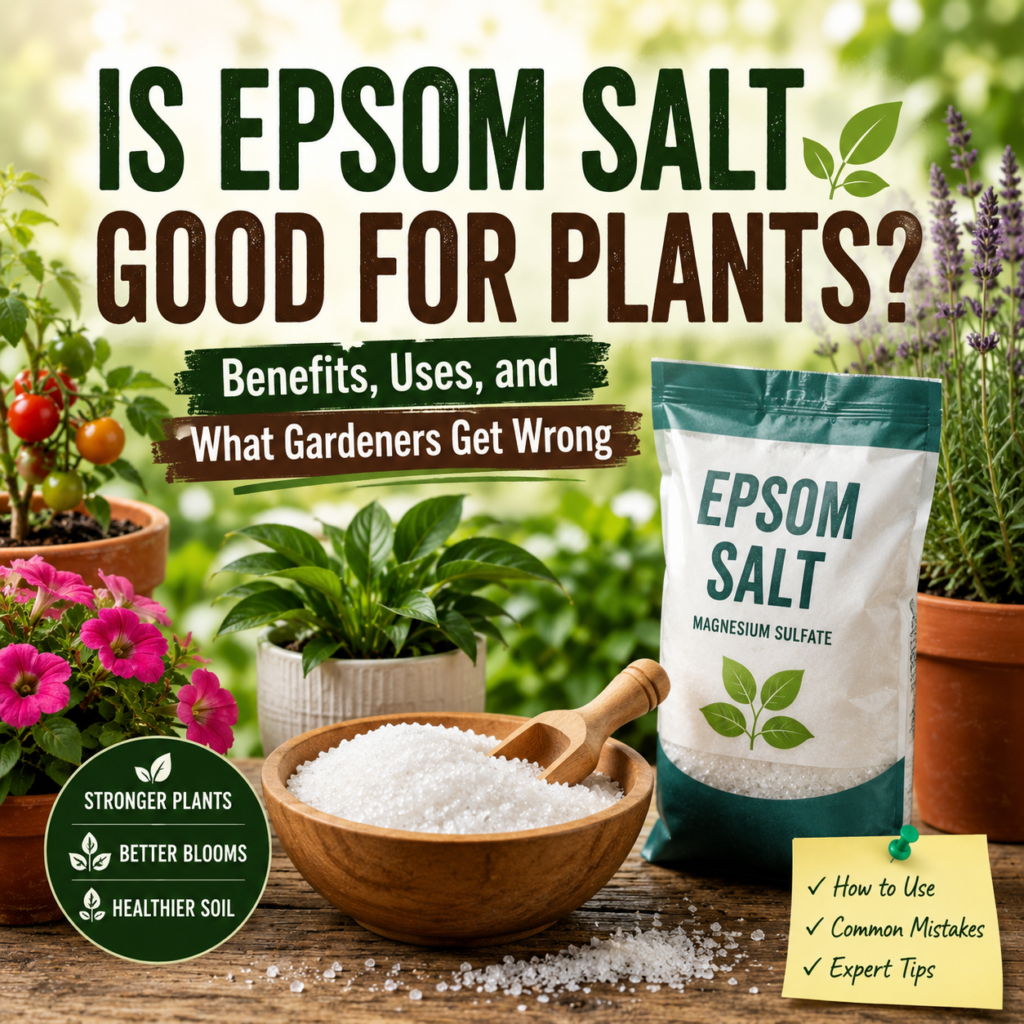
Walk into any gardening group online and someone will eventually recommend Epsom salt for everything. Bigger tomatoes. Greener leaves. More flowers. Happier houseplants. It almost sounds like a miracle fix.
But is Epsom salt good for plants? Sometimes, yes. Sometimes, absolutely not.
Epsom salt can help plants that lack magnesium or sulfur, but using it blindly on every plant may create nutrient imbalances instead of solving problems. The trick is knowing when it actually helps and when your plant is better left alone.
What Is Epsom Salt and Why Do Gardeners Use It for Plants?
Epsom salt is made of magnesium sulfate, which provides two nutrients plants use for growth: magnesium and sulfur. Unlike table salt, it does not contain sodium.
Gardeners use it because magnesium helps plants produce chlorophyll, which keeps leaves green and supports photosynthesis. Sulfur also helps with enzyme function and root health. Still, Epsom salt is not a complete fertilizer. Think of it more like a supplement than a full meal for your plants.
Epsom salt nutrients for plants explained
Epsom salt mainly provides:
- Magnesium
- Sulfur
These nutrients may support:
- Greener leaves
- Better photosynthesis
- Root development
- Stronger stems
Is Epsom salt fertilizer or just a plant supplement?
Epsom salt is a supplement, not a balanced fertilizer.
It only addresses magnesium and sulfur deficiencies. Plants still need nitrogen, phosphorus, potassium, calcium, and other nutrients to grow properly. Adding more magnesium to already healthy soil usually does not improve plant growth.
A lot of gardeners forget this part and start treating Epsom salt like plant coffee.
Is Epsom Salt Good for Plants or Just a Gardening Myth?
Yes, Epsom salt can help plants under the right conditions. But it is not the magical gardening shortcut social media sometimes makes it sound like.
Plants benefit most when soil is actually low in magnesium. If there is no deficiency, extra Epsom salt may do little or even create nutrient imbalance over time.
What science says about Epsom salt for plants
Research shows Epsom salt works best in magnesium-deficient soil. Tomatoes, peppers, and roses may respond well in those conditions.
However, excessive magnesium can interfere with calcium absorption, which may weaken plant health instead of improving it. That is why many gardening experts recommend soil testing before regular use.
Is Epsom salt good for all plants?
No. Some plants benefit from added magnesium, while others simply do not need it.
Plants already growing well in nutrient-rich soil often gain nothing from extra Epsom salt. Overusing it around sensitive plants can also stress roots and disrupt soil balance.
Can too much Epsom salt damage plant growth?
Yes. Too much Epsom salt may:
- Cause nutrient imbalance
- Interfere with calcium uptake
- Stress container plants
- Lead to mineral buildup in pots
Plants cannot tell the difference between care and overcare. Sometimes gardeners accidentally love their plants too much.
What Plants Is Epsom Salt Good For?
Epsom salt is commonly used for plants that benefit from magnesium-rich soil or show deficiency symptoms.
That usually includes:
- Tomatoes
- Peppers
- Roses
- Some flowering plants
- Certain leafy vegetables
Results still depend heavily on soil quality and overall plant care.
Epsom salt for tomatoes, peppers, and roses
Tomatoes are probably the most famous Epsom salt success story. When magnesium levels are low, Epsom salt may support greener leaves and healthier fruit production. Peppers and roses can also respond positively in magnesium-deficient soil.
That said, Epsom salt cannot compensate for poor watering, lack of sunlight, or weak soil health.
Is Epsom salt good for houseplants and indoor plants?
Sometimes.
Indoor plants grown in containers may gradually lose nutrients over time, especially if the potting mix is old. In those situations, occasional Epsom salt use may help plants showing magnesium deficiency symptoms.
Plants like pothos, peace lilies, snake plants, and ferns sometimes respond well. But healthy indoor plants usually do not need constant Epsom salt treatments.
Does Epsom salt help potted plants grow better?
Potted plants can respond faster to Epsom salt because nutrients wash out more quickly from containers.
But pots are also easier to overfeed. Too much Epsom salt in containers may lead to mineral buildup around roots, so lighter and less frequent applications work best.
If the plant already looks healthy, resist the urge to “improve” it every weekend.
What Plants Should You Not Use Epsom Salts On?
Not every plant enjoys extra magnesium.
You should be careful using Epsom salt on:
- Succulents and cacti
- Carnivorous plants
- Native plants adapted to poor soil
- Plants already receiving balanced fertilizer regularly
Adding Epsom salt unnecessarily may throw off nutrient balance and create new problems instead of fixing old ones.
A surprising number of gardening mistakes begin with good intentions.
Signs Your Plants May Need Magnesium
Before reaching for Epsom salt, it helps to know what magnesium deficiency actually looks like.
Common signs include:
- Yellowing between leaf veins
- Pale older leaves
- Weak or slow growth
- Poor flowering
- Curling leaves
- Reduced fruit production
That said, yellow leaves are not always caused by magnesium deficiency. Overwatering, poor drainage, lack of sunlight, and nitrogen deficiency can look surprisingly similar.
This is why soil testing is far more reliable than guessing based on one sad-looking leaf.
Benefits of Epsom Salt for Plants and Garden Growth
When used correctly, Epsom salt may support healthier growth in magnesium-deficient plants.
Some of the most talked-about benefits include:
- Greener leaves because magnesium supports chlorophyll production
- Better flowering and fruiting in plants like tomatoes, peppers, and roses
- Stronger root and stem growth through improved nutrient uptake
- Healthier photosynthesis which helps plants convert sunlight into energy
- Faster recovery from magnesium deficiency symptoms in some cases
Still, Epsom salt works best as a targeted solution, not an all-purpose garden hack. Healthy soil, watering, and sunlight matter far more than one spoonful of magnesium sulfate.
How to Use Epsom Salt for Plants the Right Way
Using Epsom salt correctly matters just as much as deciding whether to use it at all. Too little may do nothing. Too much may stress the plant. Most gardeners get better results with light, occasional applications instead of constant feeding.
How to mix Epsom salt for plants?
The easiest method is dissolving Epsom salt in water before applying it to soil or leaves.
For most garden plants:
- Mix 1 to 2 tablespoons per gallon of water
For indoor plants or containers:
- Use about 1 teaspoon to 1 tablespoon per gallon
Always dissolve the crystals fully before applying. Liquid application spreads nutrients more evenly and reduces the chance of concentrated mineral buildup around roots.
How much Epsom salt to use for plants
| Plant Type | Recommended Dosage | Application Method | Frequency | Why It May Help |
| Tomatoes | 1 tablespoon per gallon | Soil drench or foliar spray | Every 4–6 weeks | Supports chlorophyll production and fruit development in magnesium-deficient soil |
| Peppers | 1 tablespoon per gallon | Soil application | Every 4–6 weeks | May improve foliage and flowering when magnesium is low |
| Roses | 1 tablespoon per gallon | Soil drench around base | Once monthly | Helps support greener leaves and healthier blooms |
| Hydrangeas | 1 tablespoon per gallon | Soil application | Once monthly | Can improve leaf health in magnesium-poor soil |
| Gardenias | 1 tablespoon per gallon | Soil drench | Every 4–6 weeks | May help maintain healthy green foliage |
| Houseplants | 1 teaspoon per gallon | Watering solution | Every 6–8 weeks | Useful for container plants showing magnesium deficiency symptoms |
| Pothos & Peace Lilies | 1 teaspoon per gallon | Soil watering | Every 6–8 weeks | May reduce yellowing caused by magnesium deficiency |
| Ferns | 1 teaspoon per gallon | Soil application | Monthly during growth season | Supports lush green foliage |
| Lawn Grass | 2 tablespoons per gallon | Spray or broadcast with watering | Monthly | May improve lawn greenness in deficient soil |
| Flowering Annuals | 1 tablespoon per gallon | Soil drench | Once monthly | Supports blooming and healthy foliage growth |
Starting small is usually smarter than overdoing it immediately.
How often should I add Epsom salt to my plants?
Most plants only need occasional applications.
For garden plants, every 4 to 6 weeks is generally enough. Indoor plants need even less frequent feeding, usually every 6 to 8 weeks.
Adding Epsom salt every time you water is unnecessary and may lead to mineral buildup, especially in pots.
How long does Epsom salt take to work on plants?
Some gardeners notice greener leaves within a few days, while others may wait a couple of weeks depending on the plant and soil condition.
Foliar sprays usually work faster because nutrients are absorbed directly through leaves. Soil applications take longer but tend to last longer as well.
Gardening rarely delivers overnight transformations, despite what dramatic internet before-and-after photos suggest.
Epsom salt spray vs soil application: which works better?
Both methods can work.
Foliar spray
- Faster absorption
- Useful for quick deficiency correction
- Better for yellowing leaves
Soil application
- Longer-lasting support
- Easier for larger gardens
- Simpler for beginners
For most home gardeners, soil application is the safer and easier option.
Common Mistakes When Using Epsom Salt for Plants
Epsom salt can help plants, but many gardeners use it far more often than necessary.
The biggest mistakes include:
- Using Epsom salt without testing soil
- Treating it like a complete fertilizer
- Applying too much too often
- Ignoring the plant’s actual nutrient needs
- Adding it to already healthy plants “just in case”
More Epsom salt does not automatically mean healthier plants. In fact, excess magnesium may interfere with calcium uptake and create new deficiencies.
Plants need balance, not endless spoonfuls of supplements.
Final Verdict: Should You Use Epsom Salt for Plants?
Yes, Epsom salt can help certain plants when magnesium deficiency is the real issue.
Tomatoes, peppers, roses, and some indoor plants may respond well to careful use. But Epsom salt is not a miracle fertilizer, and using it on every plant without understanding your soil can create more harm than good.
The smartest approach is simple:
- Use it only when needed
- Apply it in moderation
- Focus on overall soil health first
Good gardening is usually less about secret tricks and more about paying attention to what your plants are actually telling you.
FAQs
What plants can you put Epsom salt on?
Epsom salt may help plants that benefit from extra magnesium, especially tomatoes, peppers, roses, and some flowering plants. It can also support certain houseplants grown in nutrient-depleted potting soil. However, it works best when a magnesium deficiency is present, not as a routine treatment for every plant in the garden.
What plants should you not use Epsom salts on?
Avoid using Epsom salt on plants that prefer low-nutrient soil, such as succulents, cacti, and carnivorous plants. Plants already growing well in balanced soil usually do not need extra magnesium either. Overusing Epsom salt can disrupt nutrient balance and interfere with calcium absorption in sensitive plants.
Can Epsom salt improve flower blooming?
Yes, Epsom salt may support better blooming in magnesium-deficient plants because magnesium helps with chlorophyll production and energy transfer. Roses and flowering vegetables sometimes respond well when soil lacks magnesium. However, healthy flowering still depends more on sunlight, watering, and balanced fertilization than Epsom salt alone.
What flowers like Epsom salt?
Flowers that may benefit from Epsom salt include roses, gardenias, azaleas, hydrangeas, and some flowering annuals grown in magnesium-poor soil. Roses are especially popular among gardeners for occasional Epsom salt use. Still, applying it unnecessarily will not automatically increase blooms or improve flower quality.
Can Epsom salt fix yellowing leaves?
Sometimes. Epsom salt can help fix yellowing leaves caused by magnesium deficiency, especially when veins stay green while surrounding leaf tissue turns yellow. However, yellow leaves may also result from overwatering, poor drainage, lack of sunlight, pests, or nitrogen deficiency. Proper diagnosis matters before treatment.
Is Epsom salt better than fertilizer?
No. Epsom salt is not better than fertilizer because it only provides magnesium and sulfur. Plants still need nitrogen, phosphorus, potassium, calcium, and other nutrients for healthy growth. Epsom salt works best as a supplement for specific deficiencies, while balanced fertilizer supports overall plant development and soil health.
Can Epsom salt make plants greener?
Yes, Epsom salt may help plants look greener if magnesium deficiency is affecting chlorophyll production. Magnesium plays a key role in photosynthesis, which gives leaves their healthy green color. However, plants already receiving enough magnesium are unlikely to become noticeably greener after additional Epsom salt applications.
How much Epsom salt to put on flowers?
For flowering plants, mix about 1 tablespoon of Epsom salt per gallon of water and apply once a month during the growing season. For potted flowers, lighter applications are safer. Overusing Epsom salt can create nutrient imbalances, so moderate use works better than frequent heavy feeding.
How often should I add Epsom salt to my plants?
Most plants only need Epsom salt every 4 to 6 weeks if magnesium deficiency is present. Indoor plants usually require even less frequent application. Adding it too often may cause mineral buildup and interfere with nutrient balance, especially in containers where excess salts accumulate more quickly.
How long does Epsom salt take to work on plants?
Plants may show improvement within a few days to two weeks depending on the severity of deficiency and application method. Foliar sprays usually work faster because nutrients are absorbed through leaves, while soil applications take longer. Visible results also depend on whether magnesium deficiency was the actual problem.